 St Mary's Church, Dymock
| Admin | |||
| . | Home | Contents | |
| H&S Policy | People Safety | Grave Yard | |
The Church & The World
Faith & Care
Faith & Care
Things Past
People & Features
People & Features
Religion Explained
Many of the words and ideas associated with religion are explained below
.
.
For an explanation of the Christian Religion, click here
.
| Religion | God | Spiritual & Physical | The Soul | Faith | Worship |
| Scripture | Prayer | Angels & Prophets | Priests | Sects | Signs |
For an explanation of the Christian Religion, click here
.
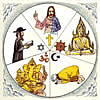
The different religions have a different understanding of god:|
Superstition: Early humans couldn't explain the great natural forces they experienced - rain, thunder, illness, etc - so believed there must be powerful 'gods' they couldn't see who control them - often believing those gods sent misfortune or illness as a punishment for doing something that displeased them. Gradually these beliefs were modified as people got to know more about how the universe works and changed their ideas, but often still kept some of the old superstitions as well.
Paganism: is a term generally applied to religions other than Christianity that focus especially on these forces of nature or on a specific 'god' associated with those forces, such as the very early middle-eastern god called 'Baal'.
.
Judaism: is the religion of the Jews (Israelites) who recognise a single supreme being called YHWH (ancient Hebrew didn't write vowels but today it's generally written as 'Yahweh'). Only priests were allowed to pronounce the name, so their God is generally referred to as 'The Lord'. The Jewish faith is recorded in 5 'Books of the Law' said to have been written by the prophet Moses, plus other books written by many people in early Jewish life that records their history, wisdom, poetry and prophecies. (In the middle ages, the name 'Jehovah' was invented by the Germans as the pronunciation of those Hebrew letters).
.
Christianity: is derived from Judaism and is named after the man Jesus Christ whom Christians believe is the 'Son of God'. The Jews anticipated a person who would be sent by Yahweh to 'save them' from the threats and persecution of neighbouring peoples - in Hebrew a 'Messiah' and when translated into Greek a 'Christ' - both names mean 'anointed' or 'chosen one' as Jesus was chosen by God as the solution to our disobedience of his Laws. Christianity is the world's biggest religion with over 2 billion members.
.
Islam: also recognises a single supreme being referred to as 'Allah' (Arabic for 'The God') and was created in 610AD by the prophet Mohammed - the name means 'submission to the will of God'. Mohammed claimed to have a revelation dictated to him by God which is recorded word-for-word in their holy Book called 'The Qur'an'. Mohammed taught that the previous religions, especially Judaism and Christianity, were completed through this revelation which is the final word of god to humanity and covers all aspects of our behaviour and relationships; so as God's final word, it cannot be updated. Islam is the world's second biggest religion with just under 2 billion members.
.
There are many other religions that interpret a supreme being and their worship in different ways, including:
Hinduism: Sikhism, Shintoism, etc: which are long established religions especially of the Middle and Far East and have many followers in those lands.
Buddhism: doesn't believe in a supreme being (a god) but is based on the teachings of a South Asian man named Siddhartha Gautama (known as 'Buddha', which means the 'Enlightened One'). He taught we should reject 'clinging' (to materialism and worldly strife) but seek 'enlightenment' as he did - which leads to an awakening and full liberation from pain and suffering.
(Return to top)
.
Today, science tells us it all began with a 'Big Bang' and has been expanding outwards ever since. Initial gases condensed into stars and planets and the many elements from which everything is made. It's so simple and yet so complex that it couldn't all have happened by chance, there must be a design, and if there's a design then there must be a designer - and that's whom we call 'God'.

.
Many also argue that this spiritual aspect is eternal - it lasts forever, unlike our physical body which has a limited life, then dies. Some think that on the death of the physical body, the spiritual aspect returns to where it came from (heaven?); others think that it's reincarnated into another body (either human or animal) to begin the cycle of life and death all over again (called 're-incarnation').
(Return to Top)

.
As a result of their experience and logical thinking, many people believe that God really exists. When you believe something is true but can't prove it, then its said that we believe it 'in faith'.
(Return to Top)
.
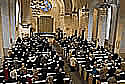
God didn't need to create people because he needed a loving relationship with us, that would have made him less than perfect. He made people because his love is so great that it overflows and he wants to share it. It's because this force of love is so fundamental that both our ancestors and us are forced to seek its source and give it its worth or the reverence due to it - which we call 'worth-ship'. If they don't acknowledge God, then many people direct that basic force into 'worship' of other things instead, like money or possessions.

.
Some teach that prayer is mainly a formal process using prescribed words and procedures which must be said by the priest, others that it can be informal too, so allow for the believer to say their own words either in 'private' prayer on their own or when gathered together for 'public' prayer such as in a place of worship. Some pray by closing their eyes and cupping their hands, others by prostrating themselves on the ground, and yet others accept any time or position is appropriate and the posture is irrelevant as it's the intention of the person praying that matters.
.
Meditation and contemplation are sometimes seen as special forms of prayer.
Meditation involves creating an aura of stillness to remove any barrier between yourself and the supreme being, allowing the person praying to concentrate more intently on God.
Contemplation is like meditation, but the mind is cleared of all thought to remove any obstacle to communication with the supreme being.
(Return to Top)
.
Angels: are 'divine' beings - that come from the presence of God in heaven.
.
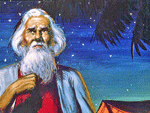
Prophets: are humans like us - but who have a special relationship with God. The holy books of many religions are full of examples of prophets in olden times (eg: Abraham, Isaiah, Mohammed) but prophets exist in every generation including ours.
.
(Divine = of or belonging to a god such as a being like an angel or a characteristic like perfect love)
.
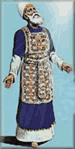
Priests are usually people ordained (ie: 'set apart') for religious duties. Many religions have priests who have public duties such as leading worship and teaching about the religion as well as providing care for the followers. Most religions provide their priests with a special form of dress to help identify them as such.
.
In some religions priests are only selected from certain social classes or groups, and in some they may be only male or only female, whilst in some religions they can be from any group or any gender.
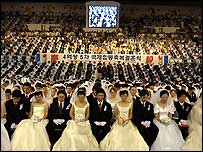 The Moonies Sect
mass wedding
.
A division that remains true to generally accepted beliefs, but puts one aspect ahead of others, is termed a Denomination. If the division adopts beliefs or practices which are contrary to generally held or 'orthodox' beliefs, then it's known as a 'Sect'.
(Return to top)
Many religions have one or more symbols that are used to depict the religion itself, or some particular aspect of it. The symbol has sometimes come about by common usage or sometimes been carefully thought out, usually based on some aspect of that religion's belief or teaching. The principal symbols for three main religions are:
 .
.
 Christian: An early symbol was the fish (still in use use today). It was selected because Jesus Christ made many references to fish eg: he selected fishermen as his first followers and said "I will make you fishers of men" (Matthew 1:16-17). The fish symbol may be used plain, or with Greek letters ΙΧΘΥΣ placed in the shape and pronounced 'Ichthys', which is the Greek word for 'Fish'. Translated into English, they represent the first letter of the Greek words "Iēsous Khristos Theou Huios, Sōtēr" which mean "Jesus Christ, God's Son, Saviour". However, the most common Christian symbol quickly became the Latin cross, because it was on that shape that Jesus was crucified - a very important element in Christian belief.
.


As Islam spread, so the symbol spread and came to be recognised as a symbol of that faith. However, many Muslims reject the symbol because of it's pagan origin and prefer no symbol at all, or a plain flag with no markings but coloured black or white or green. Islam doesn't permit images of living creatures, so geometric shapes are a common Islamic image.
(Return to top)