St Mary's Church, Dymock
| Seasons & Festivals - Acension |
| The church exists first to offer worship (honour) to God and to thank him for the gifts he gives us, and secondly to honour and support each other because we're all fellow creatures of God, and so that honours him too.
Firstly: God deserves our worship because he's the supreme being who made us out of nothing in order to have a relationship with him. We destroy that relationship by our disobedience (sin), but God restores it again through the life and work of Jesus Christ. To help us to focus on God, the church divides the year into eight main Seasons, each with one or more Major Festivals. They remind us of the important times in the life and work of God and Jesus, and consequently have major significance for his followers and so are observed by most Christians. (Return to top)
Secondly: We honour each other because Jesus told us to - he taught us that we should care for our neighbour as much as we care for our self, because in doing so we honour God who made us all. As well as the seasons and major festivals, therefore, the church celebrates several 'Special Days' throughout the year to remember, honour or support each other and our work in God's world. Celebration of the "Special Days" is usually optional, Christians chose which they want to remember. (Return to top) |
| Ascension |
| The Bible tell us that, after his death and resurrection, Jesus appeared to his disciples and many others with 'convincing proofs' that he was alive, and then went on to give them final instructions before he return to heaven. This event is the subject of the Christian Festival of 'Ascension' which is celebrated 40 days after Easter Sunday, so always take place on a Thursday. (Return to top)
At the time of the first Christians and the writing of the Bible, people still didn't know that the world was a ball in the vastness of space, neither could they fly, so they still had the idea that the earth was flat and rested on hell beneath the earth, which was therefore a bottomless pit, with heaven as the 'home of God' above the sky, where humans couldn't reach. (Return to top)
It's not surprising, therefore, that Jesus' return to God in heaven was seen at that time as 'Ascending' back to heaven, although not all the Bible accounts are that specific in their use of the word 'Ascend'. (Return to top) |

Traditional View of Jesus' Ascension |
| Matthew, Mark and Luke |
| Matthew: notes that the risen Jesus was first seen by some women disciples and he told them to tell his other disciples to meet him in Galilee, where he gave them final instructions before he returned to God, but Matthew doesn't say how he returned or give any timescale (Matthew chapter 28). (Return to top)
Mark: also records that Jesus was first seen by the women and records other meetings with the Disciples 'after' or 'later', when he gave them final instructions before being 'taken up into heaven', but Mark too doesn't give explicit detail (Mark chapter 16). (Return to top)
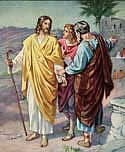
Luke: in his Gospel also has an account of the risen Jesus appearing first to the women and then to the disciples but seems to suggest it was on the Day of Resurrection - that is, 3 days after the crucifixion. Luke goes on to say that, after he had spoken with them they went out to the village of Bethany where, as he was blessing them, Jesus was 'carried up into heaven', but doesn't say how. (Luke chapter 24). (Return to top) |
| John |
| John: also has an account of the women seeing the risen Jesus first and that he told them to go and tell the other disciples. John tells us that Jesus appeared to the disciples on the evening of the same day (the Day of Resurrection) when they were gathered together in a locked room for fear of the religious authorities. But John says that the disciple called Thomas wasn't with them on that occasion, so Jesus appeared to the disciples including Thomas again a week later, and goes on to record a third meeting at daybreak when they were out fishing, but doesn't say when that was. However, John's account ends without saying anything about Jesus returning to God (John chapter 21). (Return to top) |
| Acts of the Apostles |
| Acts: Luke begins his second book, (known as the Acts of the Apostles, or just 'Acts') with a more detailed account of the 'Ascension' of Jesus back to God in heaven. He notes that Jesus gave 'convincing proofs' of his being alive again 'during forty days' before being 'lifted up and a cloud took him out of their sight' and that an angel ('angel' = a messenger from God) told the disciples that Jesus will return again at some time in the future 'in the same way as you saw him go into heaven'. (Acts chapter 1). (Return to top)
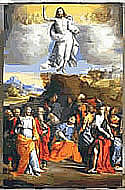
Christians therefore traditionally accept that Jesus 'Ascended' back to God in heaven forty days after Easter and it's on the fortieth day that the church celebrates the Festival of 'Ascension'. Not surprisingly, classical artists from earlier eras have interpreted the 'Ascension' in terms of Jesus physically rising up from the earth. (Return to top) |
| |
| Those Christians who see the Bible as the literal word of God usually see the Ascension as a physical rising up of Jesus in the traditional way, whilst those who see the Bible as being descriptive of fundamental truths, but limited by human language and experience, are content to agree that Jesus returned to God in heaven (since he is no longer physically seen on earth) but accept that we do not know in what form that 'return' occurred. (Return to top) |
| Religious Customs associated with Ascensiontide |
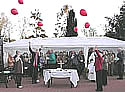
| These include a special Festival Service to celebrate Jesus' ascension. The Service is sometimes held outdoors, with or without the release of helium balloons to remind us of the act of ascending, although the release of helium balloons is now discouraged because it can damage the environment. (Return to top)
Other customs held around Ascensiontide include 'Rogation' which is held on the Sunday and three following days immediately before Ascension Day: |

Release of helium-filled balloons at an open-air Ascension Day Service |
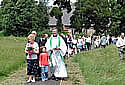
| Rogation - Blessing the Fields |
| For many years, especially in Europe, it had been the custom in the early part of the year to bless the fields in the hope of achieving a good harvest in the autumn. In 470AD a series of natural disasters had badly affected Vienne in France. Their archbishop at the time, Archbishop Mamertus, proclaimed a Fast during which the villagers were to progress around their fields, asking for God's blessing on the newly sprouting crops. As farming is vulnerable to the whims of nature, the idea caught on and is still practiced today. The Latin for 'ask' or 'beseech' is 'Rogare', hence the name 'Rogation'. (Return to top) |

Blessing the Fields |
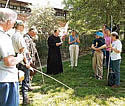
| Rogation - Beating the Bounds |
| This is an adoption of progressing round the fields to bless them - the custom traces the boundaries of the parish. In older days, before Government Social Security payments, those who had fallen on hard times had to return to the parish where they were born to receive 'poor money' or other support, even if they now lived at the other end of the country. It was not unknown for scoundrels to move the boundary markers, either to prevent the need to support someone legitimately from their parish, or conversely to move the support of someone out of their parish and into the one next door! A procession would trace the boundary and hit or 'beat' the boundary markers with sticks... and often beat the church choir or village boys who were in the procession, in order to impress on their mind where the boundaries ran. (Return to top) |

Beating the Bounds |
| Non-religious Customs associated with Ascensiontide |
These include several connected with....
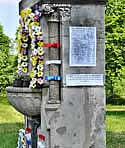
Water: One suggests that rain on this day comes 'straight from heaven' and gives good luck or has special medicinal properties, especially associated with eyes. Another involves mixing water from a well with sugar to make a special drink - in this case, the day is called 'Sugar and Water Day'. Another popular custom associated with water around this time is 'Well Dressing' when villages dress-up one or more wells with flowers and greenery. The origins lie in pagan times, making an offering to the god of the well, and continued into the Christian era when some wells were even given a Christian name such as Holy Well or St Ann's Well, etc. (Return to top)
Fire Prevention: Another superstition was to receive a piece of hawthorn picked by someone else, or even an egg laid on Ascension Day, and place it in the rafters to prevent fire in the house.
Nest Building: In Shropshire it was suggested that rooks stopped nest-building on Ascension Day.
Sheet Drying: In Lincolnshire is was said hanging out a sheet to dry on this day would bring a death to the family. (Return to top) |
|