Daffodil LogoSt Mary's Church, Dymock
925th Anniversary Year


Seasons & Festivals - Epiphany


The church exists first to offer worship (honour) to God and to thank him for the gifts he gives us, and secondly to honour and support each other because we're all fellow creatures of God, and so that honours him too.

Firstly: God deserves our worship because he's the supreme being who made us out of nothing in order to have a relationship with him. We destroy that relationship by our disobedience (sin), but God restores it again through the life and work of Jesus Christ. To help us to focus on God, the church divides the year into eight main Seasons, each with one or more Major Festivals. They remind us of the important times in the life and work of God and Jesus, and consequently have major significance for his followers and so are observed by most Christians. (Return to top)

Advent Christmas
Epiphany Lent
Easter Ascension
Pentecost Trinity

Secondly: We honour each other because Jesus told us to - he taught us that we should care for our neighbour as much as we care for our self, because in doing so we honour God who made us all. As well as the seasons and major festivals, therefore, the church celebrates several 'Special Days' throughout the year to remember, honour or support each other and our work in God's world. Celebration of the "Special Days" is usually optional, Christians chose which they want to remember. (Return to top)
Epiphany
Epiphany is a Greek word that means 'Reveal' and celebrates the revealing of Jesus to humanity. The season of Epiphany runs between Christmas and Lent and begins with the "Festival of Epiphany", which is always on January 6th. Lent always begins 46 days before Easter, but as the date of Easter is defined by the phases of the moon, so the end of the season of Epiphany varies each year as the start of Lent moves with the moon's phases. (Return to top)
Visit of the Wise Men
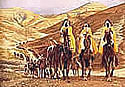
Picture of Wise Men Arriving
The Visit of the Wise Men
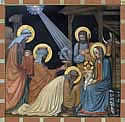
The Festival of Epiphany celebrates the visit of the three wise men to the baby Jesus. This is often celebrated as part of Christmas, with the wise men shown with the other characters in the crib scene used for the Advent Crib Service, but scholars suggest that the wise men probably arrived some time later as king Herod, who felt threatened by a rival "King of the Jews", had all boys under the age of 2 killed (Matthew chapter 2). If it had been at the time of Jesus' birth Herod wouldn't have needed to slaughter so many innocents. (Return to top)
The Baptism of Jesus
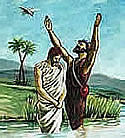
Picture of Baptism of Jesus
The Baptism of Jesus
The season of Epiphany includes the celebration of the Baptism of Jesus. Baptism (sometimes called 'Christening') is a sign of the washing away of our past wrong-doings (sin) and the start of a new life as a member of the church of Christ. Jesus was the first to be baptised into his church. As he came up out of the water of baptism, he was revealed as the Son of God, because a voice was heard saying 'This is my Son.... with whom I am well pleased' (Matthew chapter 3). Followers of Jesus to this day see baptism as an essential part of becoming a follower of Jesus - essential to becoming a Christian and being saved from our wrong doings (sin), and so eligible to be considered for eternal life after death. (Return to top)
Conversion of Saint Paul
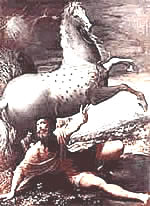
Picture Conversion of St Paul
The Conversion of St Paul
The season of Epiphany also includes the "Conversion of Saint Paul". Paul was a very devout Jew (a Pharisee) who believed that Jews should adhere absolutely to God's Laws given through the ancient prophet Moses. After the death and resurrection of Jesus, Paul made it his business to hunt down and persecute anyone who tried to follow Jesus' teachings. As he was travelling to the city of Damascus to persecute Christians there, Paul was blinded by a bright light and thrown to the ground, where he had a vision in which Jesus was revealed to him. Despite his previous impassioned persecution of Christians, Paul consequently became a Christian himself and one of the main people to spread the knowledge of Jesus, and hence Christianity, throughout the rest of the world (Acts, chapter 9). (Return to top)