 St Mary's Church, Dymock
| Admin |
| Home Contents email |
| H&S Policy Safeguarding |
| The Church in the World |
| Faith / Church |
| Things Past |
| People & Features |
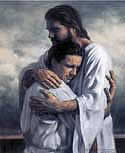
| Our ancestors believed there's something superior to us that's in charge. They imagined beings they called 'gods' who had great powers that enabled them to control powerful things they didn't understand which frightened them - like the sea, forests, and storms. They built-up superstitions around those gods to describe the things they couldn't explained any other way. (Return to top) |
 |
But 'freewill' implies that there's a choice. It's much harder to choose to behave as God wants, in fact as humans we always find that impossible because it's much easier to choose a lesser standard. It's always been like that, right from the first thinking people, described in the Bible as 'Adam and Eve' (Genesis 3:1-24). (Return to top)
As humanity evolves and we're able to understand God more and more, so he's able to reveal more about himself through his messengers, prophets, teachers and inspired writings. That includes how he wants us to behave, such as his great list of do's and don'ts in the Bible - the rules known as the 'Ten Commandments' (Exodus 20:1-17). We aren't able to live up to God's standard by ourselves, we always fail and so create a gulf between him and us, rather as you might push away a naughty child. We call the lack of love and respect for God caused by disobedience of his rules 'sin'. (Return to top)
| 'Christ' is not a surname. If Jesus had a surname no-one knows it. 'Messiah' is the Hebrew word for 'chosen' or 'anointed one'. God chose Jesus as the way to create our salvation from sin and 'Christ' is the translation of 'Messiah' into Greek, the language in which the New Testament was written, so Jesus Christ = Jesus, the chosen one.(Return to top) |
 |
Evidence for God exists in many ways but much has conveniently been gathered into the Christian Holy Book called 'The Bible'. The first part, the 'Old Testament', is an account of God's early revelation of himself to humanity and the development of his relationship with his 'chosen people', the Hebrews, so most of it was written in Hebrew. (Return to top)
The second part, called the 'New Testament', is an account of the life and teaching of Jesus Christ and the formation of the first Christian churches by his early followers. The New Testament was written at a time when Greek was the preferred language of educated people so most of it was written in Greek. The overall title 'Bible' is also Greek and just means 'Books'. (Return to top)
Each book is named after its author or its principal content, eg: the first book is called 'Genesis' which is Greek for 'Beginnings' - the beginning of the universe, of humanity and of faith in the one true God. (Return to top)
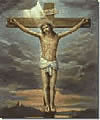
| Why did Jesus let himself be executed? Christians understand that Jesus was taking onto himself the sins of all of us, to make recompense between God and us, and thereby restore the loving relationship between God and humanity that God had always intended. As a consequence, if we accept what Jesus did for us on the cross, and are truly sorry for our sins, we have the opportunity of living eternal life with God again. Jesus did this not just for the people alive at the time he took the form of a human, but for all people who ever have, and who ever will, live - including you and me. (Return to top) |
 |
As he came up out of the water, the Bible tells us that God's Spirit descended on him much like a dove, and a voice was heard saying, "You are my Son, whom I love" (Matthew 3:13-17). He then went off on his own into the desert (the Judean wilderness) for 40 days and nights whilst he came to terms with who he was and what he was to do. He was tempted to do spectacular things to prove his divinity and to demonstrate his powers but, unlike us who eventually give in, he resisted the temptation (Luke 4:1-13). (Return to top)
From the wilderness, he moved on to the town of Capernaum in northern Israel, in the area known as The Galilee. There he gathered together a group of 12 men as 'Apostles' (Apostle is the Greek word for 'Messenger'). They accompanied him during his ministry in order to learn his message and his ways so they could take it out to the world after his death (Mark 3:13-19). (Return to top)
Jesus went round the towns and villages of The Galilee and its immediate area, teaching and healing. At this time he was well received by those who heard him and so he drew large crowds. His teaching explained the correct way of interpreting God's laws and his healing revealed God's caring love for us which established his own divinity, because only God could initiate the unusual deeds ('miracles') that Jesus performed (Matthew chapter 4-9). (Return to top)
He and his Apostles then gradually made their way to Jerusalem in order to bring his ministry to its intended conclusion. His message became less and less acceptable to the religious authorities because it was in direct conflict with their corrupt interpretation of God's rules and their self-indulgent life-style. Jesus forced this to a head as the nation prepared to celebrate the major festival of 'Passover', which recalls how God had freed them on a previous occasion, from slavery in Egypt (Matthew 26:1-5). (Return to top)Jesus was betrayed by one of his own Apostles, Judas Iscariot, taken before the Jewish religious court (Mark 14:43-65), then before the higher court of the Roman occupying authorities. To prevent the threat of civil unrest if he did nothing, the Roman governor, Pontius Pilate, had Jesus executed using the painful method reserved for common criminals, crucifixion - nailed to a cross and left to die over many hours or days (Luke 25:26-49). (Return to top)
To ensure he was dead, a Roman soldier stuck his spear into Jesus' side and blood and water came out. On the third day after his crucifixion, two of his female followers went to his tomb that had been guarded by Roman Soldiers to prevent any foul-play. They intended to anoint his body but, as he had predicted, they found it empty, he had risen back to life (John 20:1-18). The Bible tells us that over the next 40 days, Jesus appeared to over 500 people to prove that he was alive again (1 Corinthians 15:6). (Return to top)