| God, Jesus Christ, The Trinity, The Bible, Prayer, Worship, The Church
|
| Trinity - Father |

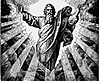
Creator God
By William Blake |
In many religions the supreme being or god is seen as being like a 'Father', since fathers (and mothers) create their offspring, and are protectors of the family. The Christian understanding of God is that he decided to create the universe and everything in it including humanity, in order that we would be in relationship with him, so that he loves and protects us like a father loves and protects their child. Christians therefore consider it right to call God 'Father' and associate the Father particularly with the original and ongoing act of creation. (Return to top)
Jesus often spoke of, and prayed to, his 'Father in heaven' as separate from himself, so that Christians understand God the Father and God the Son (see The Son below) to be separate 'parts' of God. For instance, when talking to his disciples about when the end of the world will come, Jesus replied, "No one knows about that day or hour, not even the angels in heaven, nor the Son, but only the Father". (Matthew 24:36) (Return to top) |
| References to God as Father in the Christian holy book, 'The Bible', include: |
| Deuteronomy 32:6 |
Is this the way you repay the Lord... is he not your Father, your creator? |
| Isaiah 63:16 |
You, O Lord, are our Father, our redeemer, from of old is your name |
| Matthew 6:9 |
(Jesus taught us to pray) Our Father in heaven, hallowed be your name |
| Matthew 26:39 |
(Jesus said) My Father, if it is possible, may this cup be taken from me |
| Luke 23:34 |
(Jesus said) Father forgive them, for they do not know what they are doing |
| John 14:9 |
(Jesus said) Don't you know me.... anyone who has seen me has seen the Father |
| John 20:17 |
(Jesus said) I am returning to my Father and your Father, to my God and your God |
| 2 Corinthians 6:18 |
I will be a Father to you, and you will be my sons and daughters, says the Lord Almighty |
| 1 John 1:3 |
And our fellowship is with the Father and with his Son, Jesus Christ (Return to top) |
| Trinity - Son |
|
Christians believe that God created the universe and humanity in order to be in a perfect relationship with him, and that he gave us freewill so we can freely chose to accept that relationship. Unfortunately, because of that freewill, we are unable to live up to God's standard but always fail, and that creates a rift or separation between God and us. (Return to top)
However, God loves us so much that he wants to correct that rift and re-instate the relationship. Unfortunately humanity has never been good enough, God alone is good enough to make good the rift. He did this by coming to earth himself in the form of his Son, Jesus Christ . (Return to top)
The Bible, tells us that God himself called Jesus 'my Son' (You are my Son whom I love - Mark 1:11) and his immediate followers recognised him as such (Then those who were in the boat worshipped him, "Truly you are the Son of God" - Matthew 14:32). Christians associate the Son particularly with salvation - saving us from the inevitable outcome of separation from God because of the rift caused by our disobedience. (see Jesus Christ). (Return to top) |
| References to God as Son in 'The Bible', include: |
| Matthew 11:27 |
(Jesus said) No one knows the Son except the Father |
| Matthew 28:19 |
(Jesus said) Baptise them in the name of the Father, & of the Son, & of the Holy Spirit |
| Mark 13:32 |
(Jesus said) No-one knows about that day or hour, not even the angels... nor the Son |
| John 1:34 |
(John the Baptist said) I have seen and testify that this is the Son of God |
| John 3:36 |
Whoever believes in the Son has eternal life |
| Romans 8:32 |
(St Paul speaking about God) He who did not spare his own Son |
| Hebrews 1:2 |
In these last days he has spoken to us by his Son |
| Hebrews 4:14 |
We have a great high priest who has gone through the heavens, Jesus the Son of God |
| 1 John 1:17 |
And the blood of Jesus, his Son, purifies us from all sin (Return to top) |
| Trinity - Holy Spirit |
|
The Holy Spirit is referred to throughout The Bible, both in the Old and New Testaments, and is often depicted as a dove. In the Old Testament he tends to be given for a specific purpose and may be taken away when that purpose is completed, eg: God gave his Spirit to 72 elders to enable them to prophesy on a particular occasion (Numbers 11:25). Or it may be given to a chosen individual, eg: when God chose Saul to be king of Israel (1 Samuel 10:10). But in the New Testament, after Jesus had made good the rift between God and sinful humanity, the Holy Spirit is 'poured out' on all who believe (Acts 4:31). (Return to top)
Christians associate the Holy Spirit particularly with interfacing between God and humanity, assisting us by: comforting, teaching, leading, inspiring and interpreting God's wishes and words. In this context the Holy Spirit is active in: |
| Bringing to Faith: People can tell each other about God and their experience of him, or read about him for themselves, but it's only the Holy Spirit that 'converts' people - that is, brings them to belief. (Return to top) |
| Facilitating the Christian Life: Christians believe that at baptism (ie: when an individual becomes a member of the Church), the Holy Spirit actually comes to dwell within you, helping you to live a life acceptable to God's standard (1 Corinthians 6:19). (Return to top) |
| Inspiration and Interpretation: The Holy Spirit inspires people to write about or describe God, eg: the Christian holy book 'The Bible', or a Sermon in church, or a general talk, or the person leading a study meeting, but he also interprets God's words for the hearer or reader. In that context, the interpretation may be different for different people on the same occasion, or different again on another occasion, dependent on our needs each time. (Return to top) |
| Facilitates Prayer: The Holy Spirit helps us to pray in a way acceptable to God, he helps us to find the right words when we are struggling to do so. (Return to top) |
| References to God as Spirit in 'The Bible', include: |
| Genesis 1:2 |
(At the creation of the earth) The Spirit of God was hovering over the waters |
| Judges 6:34 |
Then the Spirit of the Lord came upon Gideon |
| Nehemiah 9:30 |
(Of the ancient Israelites) By your Spirit you admonished them |
| Isaiah 30:1 |
Woe to you obstinate children.... forming an alliance but not by my Spirit |
| Matthew 1:18 |
(About Mary, mother of Jesus) She was found to be with child through the Holy Spirit |
| Luke 4:18 |
(About Jesus) The Spirit of the Lord is on me.... he has anointed me |
| Luke 11:13 |
How much more will your Father in heaven give the Holy Spirit |
| John 16:7 |
Unless I go away the Counselor* will not come to you.... I will send him to you
*The Counselor is understood by Christians to mean the Holy Spirit, eg: see Acts 1:8 or Eph 1:13 |
| Acts 1:8 |
You will receive power when the Holy Spirit comes on you... and be my witnesses |
| Acts 13:2 |
The Holy Spirit said, "Set apart for me Barnabas and Saul" |
| Romans 8:16 |
The Spirit himself testifies with our spirit |
| Ephesians 1:13 |
You were marked in him with a seal, the promised Holy Spirit (Return to top) |
| Trinity |
| Over the decades, as the early Christian church was being formed, it's members tried to make sense of the different references to God in the Bible, as well as their own experience of him. Many theories were put forward to explain God in a way that would satisfy all the different descriptions, but each in turn was found to have a flaw that failed to take into account all the concepts, so each in turn was declared a heresy (at odds with conventional belief). (Return to top)
Eventually, at a great Council in Nicaea in 325AD when all the churches were represented, a formula was agreed that satisfies all the facts - the concept of 'Trinity'. This states that there is only one God who has only one 'substance' but that he comprises three parts or 'persons' who are in perfect relationship with each other. God therefore represents the ultimate example of mutual love and co-operation. (Return to top) |

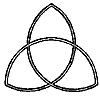
Triquetra - a symmetrical triangular arrangement of three separate interlaced arcs making a single whole |
| Why 'Trinity' |
| The word Trinity comes from the Latin 'Trinitas' which itself comes from the Latin 'Trinus' meaning 'threefold' and refers to the essence of the one and only God as having three 'parts'. The Christian idea of one God as 'Trinity' can be one of the most difficult things for people to understand. Because of it, some suggest that Christians believe in three Gods, but Christians most definitely believe that there is only one God. (Return to top)
The word 'Trinity' itself is not found in the Bible, but the Bible does describe several concepts: (1) There is one, and only one God. (2) God is described as 'Father', eg: on several occasions Jesus refers to his 'Father in Heaven'. (3) Jesus is described as God's Son, eg: when he was baptised and came up out of the water a voice was heard from heaven saying 'This is my Son'. (4) God's Spirit is described separately, eg: when God created the universe, his Spirit was said to 'Hover over the face of the waters' and Jesus said he had to return to heaven in order to send the Spirit, who would 'Lead you into all truth'. (5) Jesus said that he is "In the Father and the Father is in me", "If you have seen me you have seen the Father". (Return to top)
To explain all these points, it occurred to the early Christian thinkers that there are three 'parts' of God compared to a human being, which together make up the single whole... but how do you explain these 'parts' whilst still maintaining one whole and undivided God, or making one 'part' more important than another? (Return to top) |
| Inevitable Conclusion |
Christians believe that God has always existed and always will - he has no beginning and no end. He made the infinitely large universe and everything in it, including humanity, to live in perfect relationship with him. Clever human scientists can now create new elements in tiny quantities in an Atomic Particle Accelerator, but they need that large machine and huge amounts of energy to do it, they still can't create something from nothing, as God did when he created the universe. (Return to top)
It's clear from this and similar arguments that God is infinitely more clever than humans. That's understandable - after all God is not human, he's God - but we only have our limited human brainpower and language to describe him. It doesn't seem right to describe God as 'it' or 'thing'; the highest intelligence in the human language is the 'person', so God is described as 'three persons in one God' - Trinity. (Return to top)
The Christian concept of Trinity maintains that all three parts are equally important, no part is more important than another, all three parts are God so all are of the same 'substance', all three parts are eternal - they have and always will exist, no one part created the other. (Return to top) |
| Picturing the Trinity |
|
Artists down the ages have attempted to portray many aspects of the Christian faith, not least the concept of Trinity. One of the most famous is by the medieval Russian painter, Andrei Rublev. His picture is reckoned to show God the Father in the centre, God the Son on the left, and God the Holy Spirit on the right (with a dove over his head). (Return to top)
The problem for all artists is that they can depict the three 'persons' of the Trinity but it's very difficult to depict three persons in one 'unity'! Depiction of three persons like this sometimes leads others to think that Christians believe in three Gods. That's not true - like Jews and Muslims, Christians definitely believe that there is one and only one God. (Return to top)
One way to think of the Trinity is to consider water which can be solid (ice), but also liquid (water), and a vapour (steam). Three modes but one substance - water. Although this is a useful analogy, it's actually a heresy as it implies three 'modes' of one substance and not three separate parts of a whole. The better analogy is the 'Triquetra' figure shown above which has three separate but equal arcs, and all three are necessary to make the whole. (Return to top) |