 St Mary's Church, Dymock
| Admin |
| Home Contents email |
| H&S Policy Safeguarding |
| The Church in the World |
| Faith / Church |
| Things Past |
| People & Features |

| As a Christian, we have to respond in at least four ways: 1. Giving God his due. 2. Serving others. 3. Growing our faith. 4. Building Community. (Return to top) |
 |
God himself answered that question in the rules he gave us for living a good life. Jesus summarised them for us into just two (1) "Love God with all your heart and soul and strength and mind", in other words with your whole self, and (2) "Love your neighbour as much as you love yourself" (Luke 10:25-28). (Return to top)
| There are many styles of worship and it can be good to find a church that offers one that suits your own preference, so you can give of your best in the worship, but don't expect to find one that fits perfectly, we need a little give and take so all can worship together. (Return to top) |
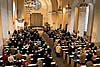 |
Modern Christian worship is usually centred around a gathering in a church building, but the first Christians gathered both in a church (the Synagogue or Temple) where they worshiped in the traditional Jewish style, as well as in their homes to 'break bread' (Holy Communion) as Jesus instructed us to do at his Last Supper (Luke 22:17-20). (Return to top)
| Saint Paul pointed out that we cannot save ourselves through doing 'good deeds' but we must trust God's Grace - that is, God's free gift to us of forgiveness. (Romans 3:21-24) But Saint James also points out that we can't just sit back and wait for God to forgive us, "What good is it if you have faith but no deeds? Just as the body without faith is dead, so faith without deeds is dead." (James 2:14-26). (Return to top) |
 |
Jesus himself showed what that means - at his Last Supper with his disciples before he was arrested and executed, he took a bowl of water and a towel and washed their dusty feet, a task normally reserved for the lowest servant. He told them that as he, their Lord and Master had done that, so we must serve others too. (John 13:1-17). On another occasion, Jesus was asked by a fellow Jew "Who is my neighbour?" and replied with the story of 'The Good Samaritan' - a man from a different ethnic group, Samaritans were detested by the Jews, yet the Samaritan cared for an injured Jew he found by the roadside (Luke 10:25-37). (Return to top)
As an individual, we can't care for everyone, but that shouldn't prevent us from caring as much as we can, such as giving some of our money to charities and some of our time and talents to help those less well-off than ourselves. We can't give to all, but equally we shouldn't ignore all. Details of some of the ways Christians respond are given under 'Christianity Into Action', click here for details. (Return to top)| Many churches provide discussion groups, sometimes all-year round, but especially in the season just before Easter called 'Lent'. St Paul wrote: Now we see but a poor reflection as in a mirror, (but when we die and return to be with God) then we shall see face to face. (1 Cor 13:12). (Return to top) |
 |
We can never understand God's mind, he's greater than us - after all he made us from nothing, but the book of Genesis tells us that when God created us, he told us to go and subdue his creation (Genesis 2:28). To do that we need to learn what he wants and how his creation works. As time passes, old ideas are clarified and new knowledge is discovered, so we need to be constantly learning about him, and seeking him. (Return to top)
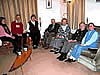
There are many different ways we can grow together. Many today involve socialising together in some way whilst we learn, such as sharing a meal or drink - it doesn't have to be academic but can be fun! (Return to top)
| St Paul put it well, "The body is a unit, though it's made up of many parts. We are all baptised by one spirit into one body.... now you are the body of Christ, and each one of you is a part of it" (1 Cor 12:12-27). Meeting with other Christians doesn't just involve going to church to worship. We need to meet with others outside of worship to build a Christian community in fellowship, getting to know each other, and to know God, as we share the bit of understanding of God we've each been given. (Return to top) |
 |
Being a Christian means being part of the 'Body of Christ' so we do need to come together with other Christians, but it needn't be in a traditional church building. Many churches expect Christians to come together with a priest several times a year to celebrate 'Holy Communion', when we remember Jesus through Bread and Wine, as Jesus himself taught us at the Last Supper (Luke 22:19-20). But we also need to meet together socially to get to know each other, and through others, to know God. (Return to top)
Today, the church is investigating 'Fresh Expressions' - new ways to be 'church' that may meet on a different day from Sunday, possibly in a church or in someone's home, or at work, or in a hall, or even on the Internet (eg: www.stpixels.com). (Return to top)