 St Mary's Church, Dymock
| Admin |
| Home Contents email |
| H&S Policy Safeguarding |
| Faith & The church |
| Church & World |
| Things Past |
| People & Features |
Experience Harvest
.
Harvest Festival is a popular time of year, nearly as popular as Christmas. But as well as the usual wheat, flour and bread, representing the harvest of the fields, there are several other harvests we should give thanks for. (Return to top)
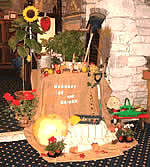
Gardening can be like farming in miniature. Farmers grow fruit and vegetables in large quantities for our tables and kitchens. Gardeners grow not just beautiful flowers, but fruit and vegetables too, only usually in smaller quantities! Autumn is a favourite time for gardeners because they're able to harvest the fruit and vegetables that they've been patiently tending for many months. They've waited for exactly the right time to dig up or cut down their crops. (Return to top)
Reflection
Every gardener knows that patience is very important. Harvesting too soon would mean that the crops were not fully grown or property ripened, but harvesting too late would result in them going rotten and being wasted. (Return to top)
Sometimes it's important for us to be patient and wait for the right time for things to happen. The Jews have been waiting centuries for God to send another saviour like their greatest king, King David. Christians believe that God has already sent him, Jesus of Nazareth, except God thinks in bigger ways than humans. He sent his Son to save all humanity, not just the Jews, and to save us from our own misdeeds not just warring neighbours, and so make us fit for his perfect kingdom – eternity – not just an earthly kingdom! (Return to top)
Being patient is a challenge, but like slow growing fruit and vegetables, growing in patience helps us grow in wisdom and maturity and helps make us fit for heaven. (Return to top)
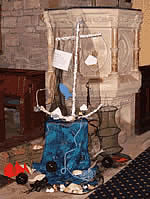
In 1995, the European Union declared that its Common Fishing Policy was failing. Stocks were being over-fished because the fishing fleets had got too big (there were too many fishermen and they were too good at it!). Too many fish were being caught so there's been a series of ever-reducing quotas to limit the amount fishermen can catch and therefore the numbers of boats... and so the amount they can earn. (Return to top)
Fishermen feel they're alone not just at sea but when they're contemplating their future too. (Return to top)
Reflection
One windy night Jesus saw his disciples, trained fishermen, struggling to sail their boat on the Sea of Galilee. They were amazed and frightened when they saw him come towards them, actually walking on the water!
The Bible tells us that Jesus spoke to them at once, "Courage! It is I", he said. "Don’t be afraid"! Then..... he got into the boat with them, and the wind died down. (Mark chapter 6: verses 50-51). (Return to top)
Although we may still have to face difficult times in our lives, knowing that Jesus is there beside us brings a peace that comes from knowing we are never alone. (Return to top)
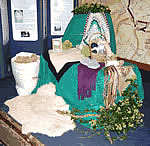
Sheep are either sheared in the early summer months, or immediately prior to winter housing. Since sheep no longer molt naturally, shearing is necessary to prevent the animals from overheating during the summer months. Shearing is often carried out by shearers from Australia and New Zealand who travel the world to shear sheep all year round. (Return to top)
From sheep, we 'harvest' meat, milk, cheese and wool – woolen threads are used to make clothes, blankets, carpets and many other useful things. (Return to top)
Reflection
Many different coloured threads are used to make a weaving on a loom. One thread on its own can't do it, just as one person on their own can't make a family, a school, or a church. (Return to top)
From the Bible we learn that everyone is precious and equally loved by God. Each person has been given gifts to share with those around them, so we must learn to celebrate and accept the gifts of others. (Return to top)
The greatest gift is God's own Son, Jesus, whom we accept with humility and thanks. Jesus compared the way he cares for us to the shepherd who cares for his sheep, "I am the good shepherd; I know my sheep and my sheep know me". (John chapter 10: verse 14). (Return to top)
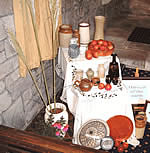
Many different metals have been extracted from the earth since pre-historic times and used to make weapons, as well as useful objects like ploughs, or objects of beauty like jewellery. (Return to top)
Clay too is harvested from the earth. People have been harvesting clay for thousands of years to make both useful and beautiful objects, ranging from giant urns for storing water, wine and oil to much smaller cups and mugs, or carefully decorated pieces of jewellery made as special gifts. We know this because museums collect and display ancient pieces of pottery that have been dug up by archaeologists at sites where our ancestors lived (There are examples of Roman pottery found around Dymock in the display case in the side aisle of the church). (Return to top)
Reflection
If you have ever made a gift for someone you love, you will know the joy that it can give to them – and to you.(Return to top)
The Bible tells us that:
Isaiah said, "In the last days.... they will beat their swords into ploughshares" (Isaiah Chapter 2: verse 4).
Jesus said, "Love God with all your heart.... and love your neighbour as yourself." (Mark Chapter 12 verse 30-31), and also:
"There is more happiness in giving than in receiving." (Acts: Chapter 20: verse 35) (Return to top)
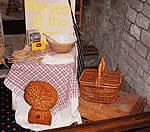
Like clay, bread too goes back to pre-historic times. Years ago, if you were put on a basic diet, such as if you were in prison, you were given just bread and the other staple we need – water. (Return to top) There are of course many other grains such as maize and barley, both used for animal feed, but barley is also used to give us a particular joy – in the flavouring of beer and whiskey! (Return to top)
Reflection
God shows great goodness in his gifts – there's enough food in the world for everyone to have enough to eat if the earth's resources are shared fairly, but many people don't have enough. 947 million people every day get less calories than are essential for healthy living. 1 child dies of hunger every 5 seconds. We all have a responsibility to work for justice for the world's poor. (Return to top)
Which charities do your family or school support to help the developing World?
Father God, thank you for the gift of bread. May we never waste what we are given. Help us to do all that we can to help those in the world who don't have enough to eat. Amen. (Return to top)
"But the fruit of the Spirit is love joy, peace, patience, kindness, goodness, faithfulness, gentleness and self-control." (Galatians 5:22) People are made from the same materials as the earth - minerals and water - but we have the "Breath of God" within us; that is, the gift of life. Like the earth, we can produce a good harvest or a bad one - useful products like wheat, fish and clay, or kindness, goodness and self-control - or we can produce weeds and desolation, like immorality and selfish ambition. (Return to top)
At the time of harvest, it's good to think about what sort of harvest we're producing from ourselves, and to remember to be faithful to God as he's faithful to us - to remember to thank him for all his gifts to us and to the earth. (Return to top)