 St Mary's Church, Dymock
| Admin |
| Home Contents email |
| H&S Policy Safeguarding |
| The Church in the World |
| Faith / Church |
| Things Past |
| People & Features |
Seasons and Festivals
Major Festivals
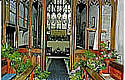
As well as the seasons and major festivals, the church celebrates several 'Special Days' throughout the year to remember, honour or support our work in God's world. Celebration of the "Special Days" is usually optional, Christians chose which they want to remember. (Return to top)
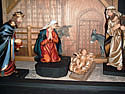
The season of Christmas lasts 12 days and runs between Advent and Epiphany. It begins with Christmas Day, December 25th and celebrates the birth of Jesus Christ. Christmas is the second most important Festival after Easter (which is the most important), although most people prefer Christmas as it's a season of merriment and partying in the otherwise dull period of midwinter (at least in the northern hemisphere). It gets its name from Christ Mass, the Mass or Service for Christ. (Return to top)
No-one knows the date of Jesus' birthday. Most cultures have many festivals and the Roman Empire was no different, they had a Festival in winter called 'Saturnalia' after one of their pagan gods, Saturn. It involved much merriment and was very popular, so the early Christians who lived at that time adopted that date as the date for celebrating Jesus' birthday to direct the Christians into worshipping Jesus rather than Saturn. (Return to top)
The season of Advent used to be austere, a time of reflection and preparation before the exertions of Christmas itself. In more recent times, there has been commercial pressure in the shops to sell Christmas products and presents, with corresponding emphasis on joyful Christmas activities rather than the more austere Advent ones. So in the secular world, Christmas preparation and celebration now tends to start some months before December 25th and occupy the period previously taken up by Advent. (Return to top)
No-one knows the date of Jesus' birthday. Most cultures have many festivals and the Roman Empire was no different, they had a Festival in winter called 'Saturnalia' after one of their pagan gods, Saturn. It involved much merriment and was very popular, so the early Christians who lived at that time adopted that date as the date for celebrating Jesus' birthday to direct the Christians into worshipping Jesus rather than Saturn. (Return to top)
The season of Advent used to be austere, a time of reflection and preparation before the exertions of Christmas itself. In more recent times, there has been commercial pressure in the shops to sell Christmas products and presents, with corresponding emphasis on joyful Christmas activities rather than the more austere Advent ones. So in the secular world, Christmas preparation and celebration now tends to start some months before December 25th and occupy the period previously taken up by Advent. (Return to top)
Carol Singers
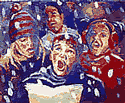
They were often sung by a group of singers moving round the area, sometimes collecting money for a good cause such as a charity, with the singers being invited into people's homes for a warm drink and traditional food such as mince pies. This still happens in many places today, although more usually now during the Advent season before Christmas Day. (Return to top)
Crib Service
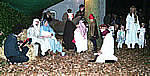
Christmas Communion
Christmas Day Communion: Many churches also hold a special Service of Holy Communion (Mass) on Christmas Day to celebrate the birth of Jesus Christ. This will usually include Christmas Carols and is often especially celebratory with the best robes for the clergy, great church decorations - especially flowers, and special anthems or religious songs if there is a choir. (Return to top)
Christmas Family Service
The Family Service is very informal and the children are encouraged to bring one of their Christmas presents to show everyone during the Service as a reminder that it's Jesus birthday we're celebrating. (Return to top)